Posted by Nicky Smol on February 24, 2026 in Other news
The maritime landscape is shifting beneath our feet. If you follow the news, you know that the “quiet” days of open sea transit are being replaced by a more volatile reality. Between the rising frequency of extreme weather events and the ongoing instability in key shipping lanes like the Red Sea, crews are facing high pressure scenarios that were once considered rare outliers. In these moments of crisis, the margin for error is zero. This has forced a serious conversation among safety officers: is our current signage enough when things actually go wrong?
The problem with traditional safety signage is that it often assumes a “best case” emergency. It assumes you have power, or at least enough ambient light to see a wall mounted sign. But in a real world engine room fire or a structural impact, the reality is pitch blackness and thick, disorienting smoke. Research shows that in high stress situations, humans lose their peripheral vision and tend to look down toward the floor. If your primary safety signs are above eye level and unlit, they effectively disappear the moment the smoke hits the ceiling.
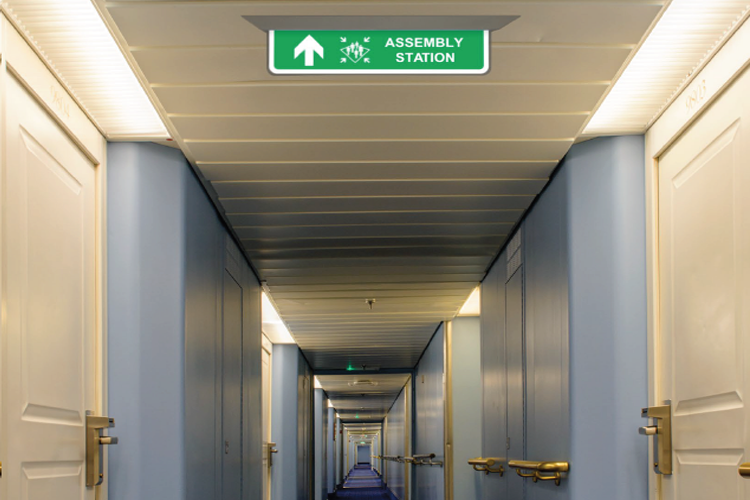
This is where the T-ISS philosophy of layered safety becomes critical. We don’t just provide signs; we provide a redundant path to survival. Our Low Location Lighting (LLL) systems are specifically engineered to sit at the deck level, below the smoke layer, where visibility remains highest. These photoluminescent strips provide a continuous, glowing “track” that leads directly to assembly stations.
Furthermore, we have integrated LED Escape and Exit Lights that act as active beacons. Unlike passive signs, our LED systems are built to withstand the intense vibrations and shocks common on large vessels or during an incident. They offer a piercing light source that cuts through haze, providing an intuitive focal point for a panicked crew member. By combining these with our high quality Reflective and Photoluminescent signage, we ensure that every pathway to safety (often thee embarkation point) clearly defined. We are moving away from the era of “compliance signage” and into the era of “active guidance,” ensuring that no matter how chaotic the situation, the way out is the most obvious thing in the room.
View our Low Location Lighting products: https://t-iss.com/category/low-location-lighting/
View our LED escape/EXIT lights: https://t-iss.com/category/electrical-escape-signs/