
Clear and consistent Pipe Marking on ships and offshore installations helps prevent confusion, accidents, and regulatory issues. The foundation for Maritime Pipe Marking lies in ISO 14726, which defines a system of base colors for identifying different types of substances in shipboard piping. The standard also allows for additional color bands to provide more detailed substance identification. According to ISO 14726, pipes must be marked:
Beyond basic identification, recognizability is determined by strategic placement, format, color, and design. Using standardized color coding improves readability and reduces dependence on text alone—critical in multilingual or emergency environments.
In addition to ISO 14726 (specific to shipping), other widely adopted standards include:
These standards promote harmonization in layout, color coding, and symbol use, improving safety and awareness across industries and regions.
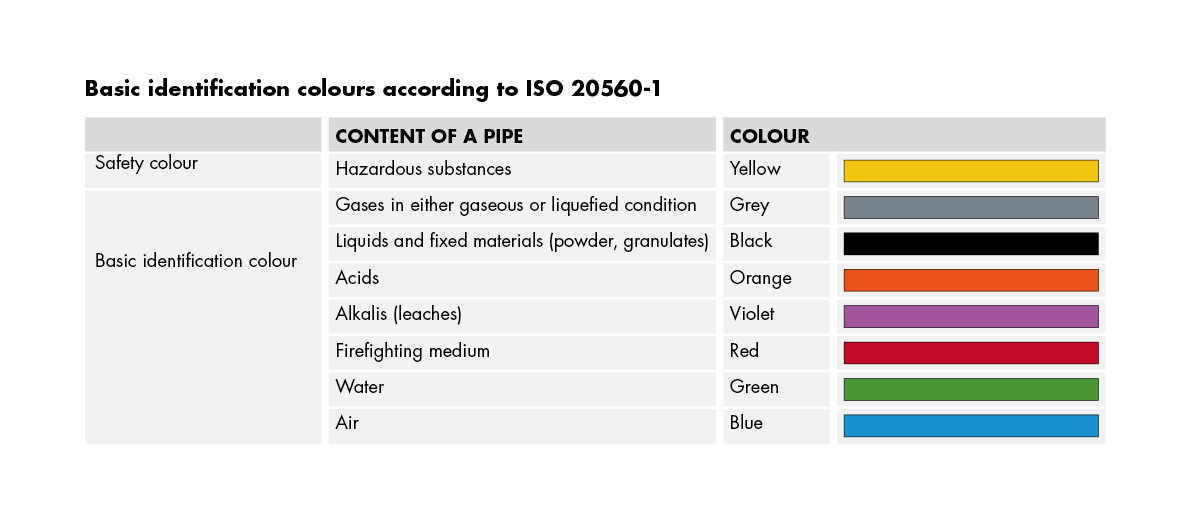
The ISO 20560-1 combines technical information about the contents and identification of pipes with safety information, aiming to have one global safety language for all workers at installations, both on land and maritime.
Key facts ISO 20560-1
• Display content name and flowdirection
• Yellow safety colour for recognition the pipe-content is hazardous
• Warning symbols for hazards according to Safety Data Sheet and other process related risks
• Other safety related information, such as pressure, temperature, speed, etc.
• Technical process information, such as pipe numbers, from-to information, classification code, etc.
Pipe markers according to ISO 20560-1, quality Polyespro, can be supplied as rolls, length 6 or 12 meter, or as a sheet for a single wrapper. The width of the marker depends on the amount of safety symbols and the diameter of the pipe.
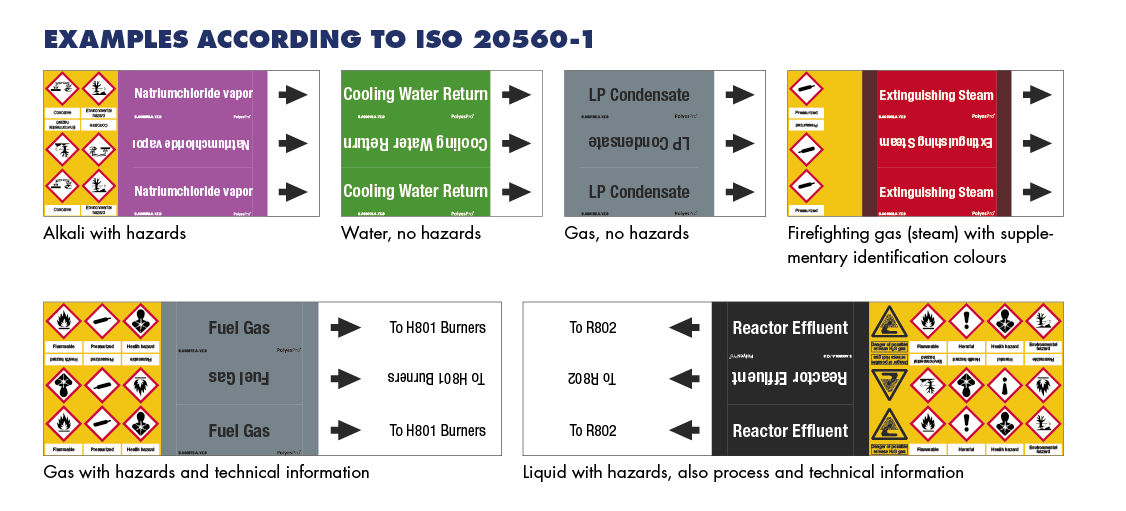
The Globally Harmonized System (GHS), developed by the United Nations, provides internationally recognized hazard pictograms for the classification and labeling of chemical substances and mixtures. In Europe, GHS is implemented via the CLP Regulation (EC) 1272/2008, which replaced older EU directives in 2009.
According to GHS and CLP, hazard pictograms must be included on all relevant pipeline markings—especially on storage tanks and pipes transporting dangerous substances. This ensures immediate risk recognition and enhances workplace safety.
The type of pipe marking suitable for your vessel depends on several factors, such as the type of vessel, the substances being transported, the operational environment, and applicable international standards like ISO 14726 or ISO 20560. In some cases, additional elements like GHS pictograms or custom layouts may be required.
At T-ISS, we understand that every project is different. That’s why we offer tailored advice to help you choose the pipe marking solution that best fits your vessel’s layout, compliance requirements, and operational needs. Feel free to contact us—our team is ready to assist you with expert guidance.
Want to know more about our products?
Please contact us.
