
A Low Location Lighting (LLL) system is a critical safety feature designed to guide passengers and crew to emergency exits during conditions of reduced visibility. Under the requirements of SOLAS Chapter II-2, all passenger vessels must be equipped with a Low Location Lighting (LLL) system. Passenger vessels include cruise ships, ferries, and offshore vessels carrying non-crew personnel.
In addition to passenger vessels, Low Location Lighting systems are also installed on offshore and maritime installations, including production platforms, drilling rigs, and other fixed or floating facilities.
Low Location Lighting (LLL) systems must be inspected and tested at least once every five years. T-ISS is accredited by DNV to perform Low Location Lighting inspection, testing, and measurement services in accordance with the applicable standards (see our DNV accreditation).
At T-ISS, we perform Low Location Lighting inspections using annually calibrated measurement equipment. Our qualified engineers measure the luminance of photoluminescent LLL systems and test electrically powered LLL systems on board. Both testing procedures are certified by DNV.
Upon completion of the inspection, a detailed report is provided containing all measurement values, test results, and any observations. If the system complies with the applicable requirements, a certificate valid for five years is issued.
Should any non-conformities be identified during the inspection, we will provide clear recommendations to help you achieve compliance. Depending on the findings, this may include improvements to the illumination system, replacement of photoluminescent materials, battery replacement, or other corrective actions. Where required, we also advise on any upgrades or modifications needed to ensure your Low Location Lighting system complies with ISO 15370 and the latest applicable safety regulations.
Examples of our Low Location Lighting certification Services:
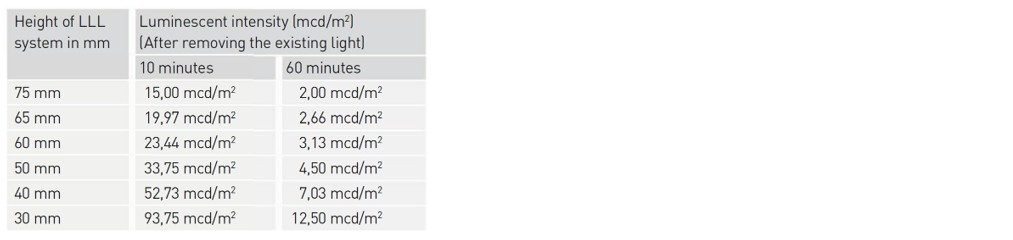
The applicable rules, regulations, and standards classify the luminance of signage and Low Location Lighting (LLL) systems as shown in the table below. SafeSign products meet or exceed the required luminance levels. By measuring both the illuminance of the actual lighting conditions and the frequency of the ambient lighting, we can advise on the appropriate corrective actions in the event that the photoluminescent LLL system does not meet the required performance.
The values listed in the table, in accordance with IMO Resolution A.752(18), apply to photoluminescent LLL strips with a width of 75 mm. For all other widths, the values must be recalculated as specified in ISO 15370:2021, Annex D.
The table below shows the minimum required luminance values for different strip widths.
Low Location Lighting (LLL) measurements and testing make sure that emergency escape routes will always be clearly visible in low-visibility conditions, such as smoke-filled corridors or power outages. The purpose is to ensure that people can safely reach the nearest exit and the assembly station in the event of an emergency.
All passenger vessels must be equipped with an LLL system—either photoluminescent or electrical—that meets the requirements of IMO A.752(18) and ISO 15370. This ensures that systems are reliable and provide effective illumination for 60 minutes at a minimum when it matters most.
Because materials degrade over time, LLL systems must be tested and certified every five years. They are essential for maintaining certification from classification societies, such as DNV, Lloyds and others, ensuring vessels remain compliant and prepared for inspections.
Both electrical and photoluminescent LLL systems will be inspected on completeness according to ISO 15370. Electrical powered systems must demonstrate at least 60 minutes of emergency-powered operation. The purpose of a photoluminescent LLL measurement is to verify whether the luminance of the system still meets the required minimum values mentioned in ISO 15370.
All T-ISS engineers are experienced with the by DNV certified testing procedures and use high-precision calibrated equipment for accurate measurements. The approach to testing differs between electric and photoluminescent systems.
If the system fails to meet the minimum luminance requirements, the illumination level of corridors or staircases must be upgraded or the LLL system must (partly) be upgraded or replaced. T-ISS specializes in the renewal and installation of LLL systems for cruise ships, ferries, and other passenger vessels.
Would you like more information about system upgrades or replacements? Don’t hesitate to contact us or visit the relevant product page for further details.
A complete safety sign system consists of high-located safety signs, Low Location Lighting system and the safety instructions required for passenger vessels, all in accordance with SOLAS and other regulations and ISO standards.
Highly located safety signs are to be used for escape, rescue, firefighting, fire control and other safety signs such as mandatories, prohibitions and hazards. As part of our turnkey safety solutions, T-ISS provides professional engineering according to the ship’s Fire Control and Safety plan and installation services for safety signs, Low Location Lighting systems, and pipe marking. Our skilled engineers ensure all installations are executed to the highest standards.
Examples of Our Safety Sign Services:
Choosing T-ISS means choosing peace of mind. If you need the 5-year required LLL testing carried out on your vessel, our team is ready to help. We’ll advise you based on your vessel’s specific situation and requirements.
Once the testing inclusive measurement process is completed, our engineer will provide a clear report so you are certified for the next 5 years. This includes all readings and any suggested possible improvements to bring your system in line with regulations.
Want to know more about our products?
Please contact us.
